On this page 8 sections
Post-quantum migration plans usually start with servers, networks and certificates. The apps on your users’ phones open many of the connections that carry your most sensitive data, yet they rarely make the list. In our work on Android apps, we kept running into the same question: can this app negotiate post-quantum key exchange today, and if it cannot, why not? The answer depends less on which libraries an app contains than on how its code configures them. This post explains why, what the 2026 deadlines mean for mobile, and what to ask the vendors who build your apps.
TL;DR
- The post-quantum deadlines are now concrete. US Executive Order 14412 sets December 31, 2030 for post-quantum key establishment and December 31, 2031 for post-quantum signatures in high-value federal systems. NIST’s final IR 8547 deprecates every quantum-vulnerable public-key algorithm after 2030 and disallows them after 2035. Australia’s ASD recommends ceasing traditional asymmetric cryptography by the end of 2030.
- Every serious migration guide starts in the same place: an inventory of your cryptography. The format for that inventory is a cryptographic bill of materials (CBOM).
- Mobile apps are the part of the estate most often left out. They also behave differently from servers: an app’s post-quantum outcome depends on which TLS stack it uses, which device it runs on, and how its own code configures that stack.
- “Does the app contain post-quantum code?” is the wrong first question. The better question is: at each configuration point, can this app negotiate post-quantum key exchange, and if not, why not?
- Byteria is building a CBOM product for exactly this question. It starts with Android and produces a standard CycloneDX CBOM from the app binary.
The Deadlines
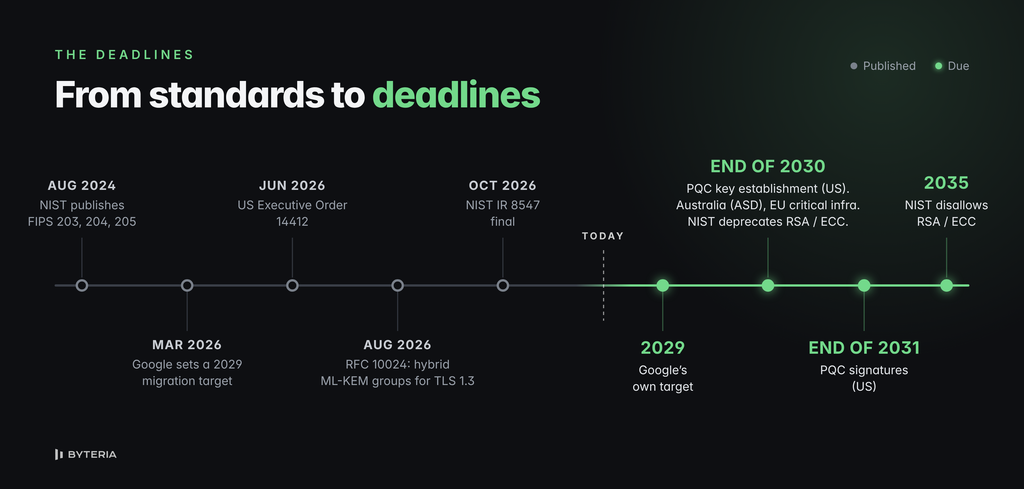
For years, post-quantum cryptography (PQC) planning ran on estimates. In 2026 it started running on deadlines.
- United States. Executive Order 14412, signed June 22, 2026, requires agencies to move all high-value assets and high-impact systems to PQC for key establishment by December 31, 2030, and for digital signatures by December 31, 2031. Federal contractors are directed toward the same 2030 line.
- NIST. On October 27, 2026, NIST published the final NIST IR 8547, Transition to Post-Quantum Cryptography Standards. The final version is stricter than the 2024 draft. RSA-3072, P-256 and Ed25519 are no longer spared: every quantum-vulnerable signature and key-establishment algorithm is deprecated after 2030 and disallowed after 2035, whatever its key size.
- European Union. The Coordinated Implementation Roadmap asks every member state to start its transition by the end of 2026, and to move critical infrastructure to PQC as soon as possible and no later than the end of 2030.
- Australia. ASD’s Information Security Manual recommends ceasing traditional asymmetric cryptography (RSA, Diffie-Hellman, ECDH, ECDSA) by the end of 2030.
- Industry. Google has set 2029 as the deadline for its own migration. It cites progress in quantum hardware, error correction and factoring resource estimates.
Two threats run on two different clocks.
Encryption is at risk today. An attacker can record encrypted traffic now and decrypt it once a cryptographically relevant quantum computer (CRQC) exists. This is “harvest now, decrypt later”. Any data that must stay confidential beyond about 2030, such as health records, financial history, identity documents or trade secrets, is already exposed when it crosses the network under classical key exchange.
Signatures are at risk later, but take longer to fix. A forged signature only matters once a CRQC exists. But signatures sit in certificates, firmware, app signing and identity systems, and those take years to replace. That is why Google has moved authentication up its priority list.
The lesson from every one of these documents is the same: migration takes years, and it cannot begin until you know what you are migrating.
Where PQC Already Runs
Post-quantum key exchange is already more widespread than most people expect.
- In October 2025, Cloudflare reported that the majority of human-initiated traffic it served was already protected by post-quantum encryption. In its 2025 Year in Review the share had reached 52%.
- Chrome has used the hybrid X25519MLKEM768 key exchange by default for TLS 1.3 since Chrome 131, and Android WebView follows Chrome.
- On iOS 26, Apple enables TLS 1.3 with X25519MLKEM768 by default for apps that use URLSession and the Network framework.
- Android 17 brings ML-DSA to Android Verified Boot, to remote attestation and to Android Keystore. The platform will also verify post-quantum signatures over APKs. Through Play App Signing, Google Play will generate hybrid signature blocks that combine classical and ML-DSA keys: for new apps, and for existing apps that opt in. Google calls this the first phase of Android’s post-quantum transition (Google, March 2026).
This is real progress. But it creates a dangerous assumption: “the platform handles it, so our apps are fine.”
On mobile, that assumption fails more often than it holds.
Why Mobile Is Harder
A web browser has one TLS stack. A mobile app can have several, and the app’s own code decides how each one is used.
1. The TLS stack varies from app to app. An Android app may talk to its backend through:
- the platform’s own Conscrypt provider;
- a copy of Conscrypt bundled in the app;
- Google Play services’ security provider;
- Bouncy Castle’s JSSE;
- Cronet, which carries Chromium’s network stack;
- or, in a Flutter app, Dart’s BoringSSL inside the engine.
Each has its own post-quantum story. On iOS, Apple’s default covers URLSession and the Network framework. An app that brings its own TLS stack does not inherit it.
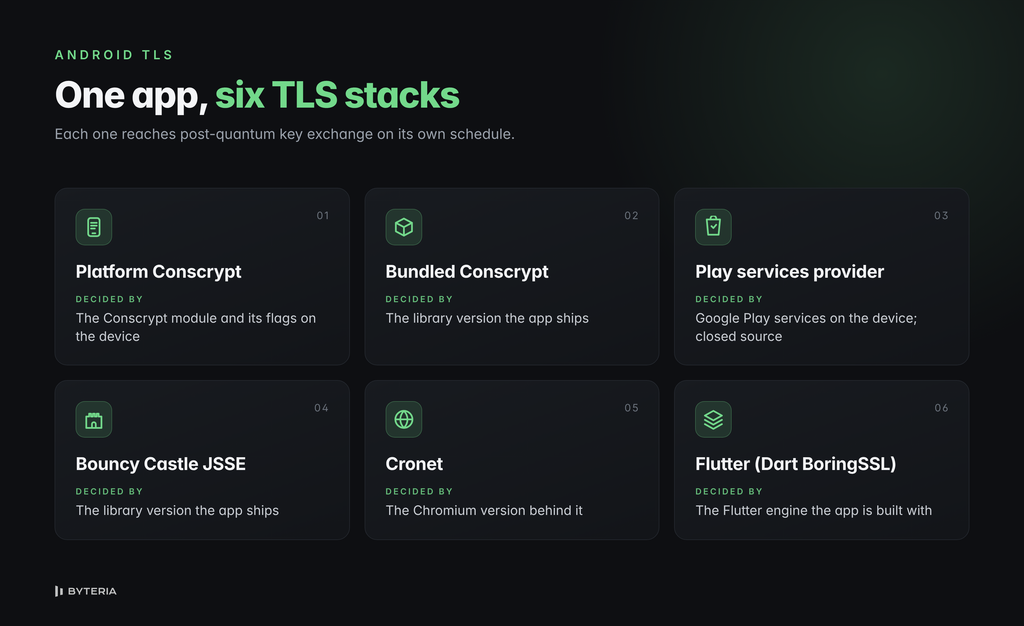
2. The device matters, not just the app. On Android, the platform TLS stack is Conscrypt, a Mainline module updated through Google Play system updates. Conscrypt 2.7.0, released on August 31, 2026, uses X25519MLKEM768 by default in TLS. That is the release an app can bundle. On the platform, the same change ships in the Conscrypt module behind a flag (our reading of AOSP source, November 2026), so whether a phone offers post-quantum key exchange depends on the module and the flags it runs. Older devices that no longer receive Mainline updates keep the Conscrypt they shipped with. The same app binary can therefore negotiate post-quantum key exchange on one phone and classical key exchange on another.
3. The app’s own code can rule it out. The hybrid groups standardized in RFC 10024 (August 2026), X25519MLKEM768 among them, are defined for TLS 1.3 only. An app that restricts its sockets to TLS 1.2, fixes its own list of key-exchange groups, or pins an old bundled library can prevent post-quantum key exchange, even on a device and against a server that both support it. A single line decides this. On Android’s own TLS stack, an SSLContext created with getInstance("TLSv1.2") does not enable TLS 1.3 by default on any Android version, while getInstance("TLS") does from Android 10. A setEnabledProtocols call or an OkHttp ConnectionSpec that lists TLS 1.2 only has the same effect, often deep inside a third-party SDK.
4. Weak cryptography has not gone away. Post-quantum readiness does not replace basic hygiene. Inventories of real apps still find DES, ECB mode (often through a bare Cipher.getInstance("AES"), which on Android means ECB), hardcoded keys and trust managers that accept any certificate. A post-quantum plan built on top of these issues inherits them.
Presence Is Not Protection
“Does the app contain post-quantum code?” is the question most scanners start with, and as a first pass it is reasonable. Look inside the binary for ML-KEM, ML-DSA or a post-quantum-capable library, and count what you find. It is fast, it scales to thousands of apps, and it quickly shows how little of the mobile estate has been touched.
On mobile, though, the answer says little about what happens on the wire. Finding post-quantum code in an APK proves that the code ships, not that it runs. A typical Android app carries dozens of SDKs. A cryptographic library that one of them pulls in for an unrelated feature tells you nothing about how the app’s own connections are protected.
The logic also runs the other way. An app with no PQC library at all may already negotiate post-quantum key exchange, because the platform’s TLS stack does it on the app’s behalf. An app that ships a PQC-capable library may never use it, because a single line of its own configuration caps TLS at 1.2.
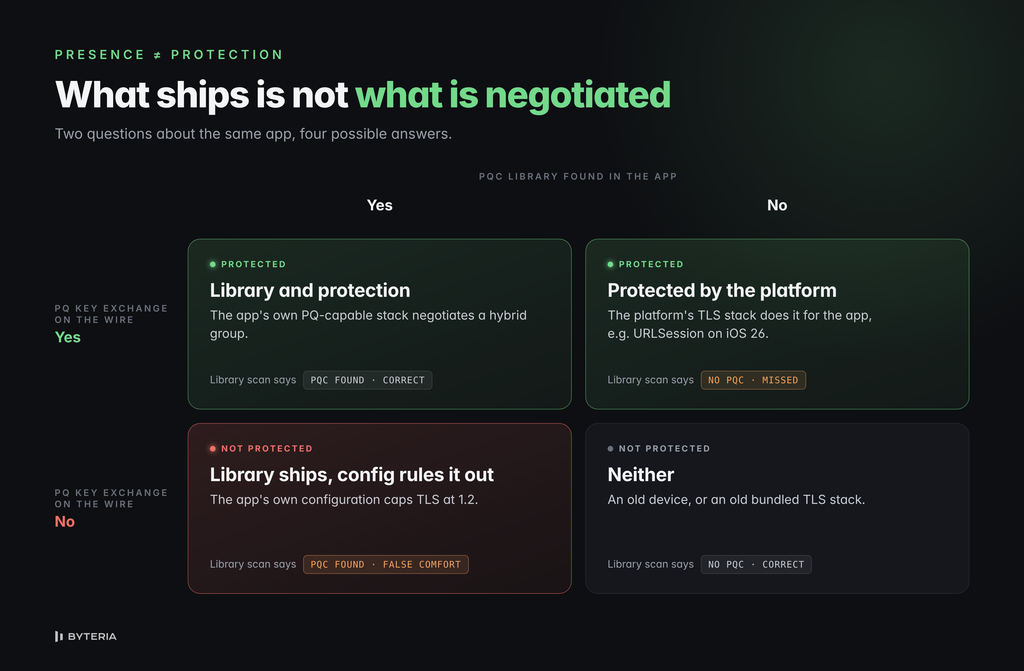
For mobile, the question that leads to action is more specific:
At each place where the app configures TLS, which stack is used, which protocol versions and groups are allowed, on which Android versions, and does that configuration allow post-quantum key exchange or rule it out?
Answering it requires reading the configuration, not just detecting libraries. That is what a mobile CBOM should do.
What a Mobile CBOM Should Capture
ASD describes a mature CBOM as one that “details the cryptographic implementations in the context they are used”. It captures products, software, libraries, algorithms, protocols, parameters, versions and configurations. For a mobile app, that means:
- Algorithms and their parameters: cipher, mode, padding, key size, curve; and which provider the code asked for.
- Keys and certificates: type, size and source. Never the secret values themselves.
- Protocol configuration points: every
SSLContext, every protocol or cipher-suite list set on a socket, every OkHttpConnectionSpec, and every scope of the Android network security config. - The TLS stack behind each point: platform, bundled or native.
- The Android versions each answer holds on: a configuration can mean TLS 1.3 on one API level and a failed call on another.
- The library each finding belongs to: so that the right team, or the right vendor, owns the fix.
- What could not be determined: an honest “unknown” is more useful than a confident guess.
It should use a standard format. CycloneDX added CBOM support in version 1.6, and CycloneDX 1.7 was ratified as ECMA-424, 2nd Edition in December 2025. A standard CBOM can be fed into the tools, audits and procurement processes your organization already uses.
What We Built
We did not set out to build a CBOM tool. We set out to answer one question about the Android apps we test: can this app negotiate post-quantum key exchange, and if it cannot, why not? Existing tools could list the cryptographic libraries in an APK, but not what each SSLContext or socket actually allowed, through which TLS stack, on which Android version. So we built a static analyzer that does. It takes an APK or a split bundle (.apks, .xapk), never runs it, and writes a CycloneDX 1.7 CBOM.
Configuration, not presence. A single line can decide the answer. Take a pattern we see again and again in apps and SDKs:
socket.setEnabledProtocols(new String[] {"TLSv1.2", "TLSv1.3"});On Android 10 and later, this enables TLS 1.2 and 1.3. On Android 9 and earlier, the platform’s TLS stack does not recognize "TLSv1.3" and the call throws; if the code catches it, the socket keeps its previous settings and never gets TLS 1.3. If the app puts a bundled Conscrypt in front, the same call can succeed on Android 9 too. Same line, same binary, different outcomes, and a library scan sees none of it. Our CBOM records the answer by API level, read from the platform’s own source code:
| API level | What the call does on the platform’s TLS stack |
|---|---|
| 1–14 (Android 4.0.2 and earlier) | Not described; recorded as unknown |
| 15–28 (Android 4.0.3 to 9) | Throws; if the code catches it, the socket keeps its previous settings, never TLS 1.3 |
| 29 and later (Android 10 and later) | Enables TLS 1.2 and TLS 1.3 |
What it covers. Every SSLContext, every protocol and cipher-suite list set on a socket, an engine or SSLParameters, every OkHttp ConnectionSpec and every network security config scope, each with the TLS stack behind it: the platform’s Conscrypt, a bundled Conscrypt, Google Play services’ provider or Bouncy Castle’s JSSE. For Cronet, Flutter’s engine or a bundled OpenSSL, it reads the stack’s release and, for releases we have checked, whether it offers hybrid key exchange by default; how the app’s Dart or native code configures them is listed as not assessed. Algorithms, keys and certificates go into the same CBOM, each tied to the library it belongs to.
What it answers. For each configuration point and range of Android versions: the app’s code rules post-quantum key exchange out; the code asks for a hybrid group first; or the stack’s default decides, and that default is hybrid, classical, or depends on the device. A TLS 1.2 cap on Android 9 and earlier, where the platform offers no TLS 1.3 at all, is not counted as the app’s decision.
What it will not do. It does not guess: a value it cannot determine is written as “unresolved”. We test it against reference inventories of real apps built by hand, counting wrong and unknown values separately, and the bar for wrong values is zero. It never writes secret values, such as hardcoded keys, to the CBOM, not even as a hash. And it runs offline, in a container with no network access, so the APK never leaves your infrastructure.
Built for every release. Asset identifiers depend only on the app’s code, so the CBOMs of two releases made with the same analyzer version can be compared directly. An optional evaluation step adds a risk class (weak, quantum-vulnerable or unresolved), a CWE where one applies, and a recommendation. A CI pipeline can then fail a build only when something new and weak or quantum-vulnerable appears.
We started with Android because that is where the answer depends on the most moving parts. iOS is next on our roadmap.
Where to Start
You do not need a full migration program to take the first step. You need an inventory you can trust.
- Name an owner. Post-quantum readiness for mobile falls between AppSec, infrastructure and procurement. One person needs to own it.
- List your apps and the SDKs inside them. Include the apps you build, the apps vendors build for you, and the SDKs both ship.
- Generate a CBOM for each app’s current release. Start with the apps that handle data with the longest confidentiality lifetime.
- Rank by what you find. First fix the configuration points where the app’s own code rules out post-quantum key exchange. Then fix weak algorithms and hardcoded keys.
- Check the server side. Confirm that your backends and CDNs accept hybrid key exchange.
- Repeat for every release. Compare each new CBOM with the last one, so that regressions are caught before they ship.
You cannot migrate what you have not inventoried. On mobile, the inventory has to go below “which libraries are in the app” to “what does each configuration point actually allow”. That is the inventory we are building.
To see a CBOM of one of your own Android apps, contact the Byteria team.